
Does your cat need an ID tag if they're already microchipped?
Your cat is microchipped, the vet has scanned it, your contact details are registered on the database. So the question of a cat ID tag jingling away on a collar can feel unnecessary. If there's already a chip under the skin doing the hard work, why add a tag on top?
It's a fair question, and a common one, especially in warmer months when cats wander further and doors and windows stay open for longer. The short answer: a microchip and a cat ID tag do two very different jobs, and your cat is safest with both. Here's why.
What a microchip does (and what it doesn't)
Microchipping is one of the best things you can do for your cat. In many countries and regions, it's already a legal requirement; in others, vets and animal welfare organisations strongly recommend it. Either way, getting your cat microchipped is a simple, one-off step that gives them permanent identification.
If you've never seen one up close, a microchip is tiny (about the size of a grain of rice) and sits under the skin between the shoulder blades. A vet places it with a quick injection, often while your kitten is in for an early check-up or neutering. From then on, a scanner held over the back reads the chip's unique code, which links to your details on the registration database.
It's reliable, permanent identification. But the part many owners miss is that a chip only works when someone has a scanner. Your local vet or animal shelter can read it, but an ordinary person who finds your cat on the street cannot. And if your details on the database are out of date, even a scan won't lead back to you.
So why does a microchipped cat still need a cat ID tag?
Picture the scenario. Your cat slips out, gets a fright and ends up several streets away. A kind neighbour finds them sitting on a wall, clearly someone's pet, well-fed and friendly. What happens next?
If your cat is microchipped but wearing nothing, that neighbour has no way of knowing who to call. They'd need to catch the cat, keep hold of them and take them to a vet or shelter to be scanned, and plenty of people simply can't do that, or assume the cat will find its own way home. Hours or days pass.
If your cat is wearing a collar and tag with your phone number, the neighbour reads it, sends a quick message, and you're on your way to collect them within the hour. That's the whole point of a cat ID tag: it lets any ordinary person reunite you with your cat straight away, with no scanner, no car journey and no trip to the vet.
A microchip is your backup. A tag is your front line. The two together give a cat who's gone missing the best possible chance of getting home, and getting home quickly.
Do cats even need collars and ID tags?
In most places, the rules around collars and tags are stricter for dogs than for cats. Your cat may not be legally required to wear one, but that doesn't mean it isn't worth it.
Think of it this way: official identification like a microchip is there for the system (vets, shelters, databases). A tag is there for the everyday person who spots your cat somewhere it shouldn't be. Most vets and rescue organisations will tell you a visible tag is one of the simplest things you can do to get a wandering cat home.
What to put on your cat's ID tag
You don't have much room on a small tag, so keep it to what matters. A good tag usually includes:
-
Your phone number — a mobile is best, so you can be reached wherever you are.
-
A second contact number — if there's space, a partner or family member, for when you're unreachable.
-
"I'm microchipped" — a gentle prompt that tells a finder there's more information available through your vet or local shelter.
-
Your house number or street — if you'd rather not lead with a phone number alone.
One thing owners often debate is whether to put the cat's name on the tag. There's no right answer; some prefer to leave it off so a stranger can't call the cat over by name. Your contact number is the part that actually brings them home, so make sure that's the clearest thing on there and double-check it's correct before it goes on the collar.
Choosing a collar your cat will actually wear
A tag is only useful if your cat will wear a collar to hang it on, and this is where a little care pays off.
Always choose a quick-release or 'breakaway' safety collar. These are designed to pop open if your cat gets snagged on a branch or fence, so they can't get trapped or hurt. Steer clear of buckle collars made for dogs.

Every collar in our range is breakaway as standard. If you're starting from scratch, the Essential Breakaway Cat Collar covers everything you need. For a cat who likes to wander, the Reflective Breakaway Cat Collar with AirTag Holder adds visibility after dark and a slot for a location tracker. And if you'd like something a little smarter, the Luxury Breakaway Cat Collar with Crystals keeps the same safe quick-release fastening with a bit more sparkle.
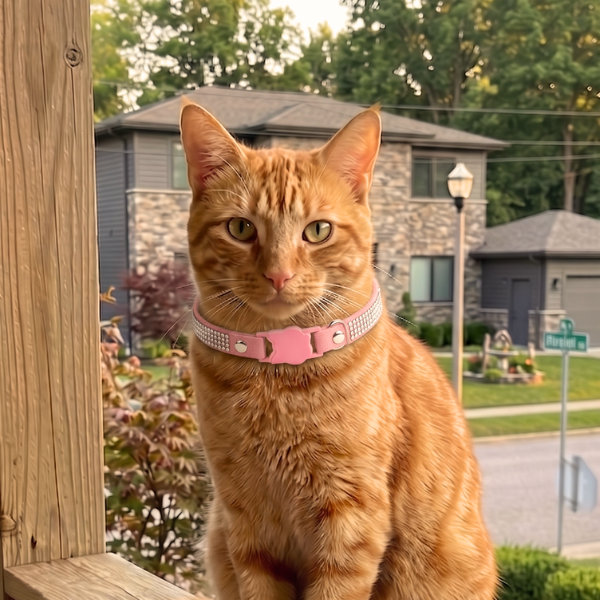
Check the fit with the two-finger rule: you should be able to slide two fingers comfortably between the collar and your cat's neck, snug but not tight. Introduce it slowly, ideally while they're a kitten, with plenty of fuss and a few treats so they barely notice it's there.
And if your cat flatly refuses to wear a collar? Some cats won't, and that's all right. In that case, lean harder on the chip: make sure your microchip number is registered and your contact details on the database are fully up to date, so a scan will always reach you.
The detail most owners forget: keep your information current
A microchip and a tag are only as good as the information attached to them. The single most common reason a found cat isn't reunited quickly is out-of-date details: an old phone number, or a database record still pointing at a home you moved out of years ago.
It's worth a five-minute check today. Log in to your pet registration database and confirm your phone number and address are correct, and that you're listed as the current keeper. Do the same every time you change your number or move home. And when you read your cat's tag back to yourself, ask the obvious question: if a stranger found your cat right now, could they actually reach you? If the answer's yes on both the chip and the tag, you've done the job properly.
Warm weather means more wandering
Cats roam more when the weather turns warmer. Windows and doors stay open, daylight stretches into the evening, and even a contented indoor cat can be tempted out for an adventure. More time outdoors means more chances to go missing: over a fence, into a neighbour's shed, or simply too far from home to find the way back before dark.
Sorting a collar and tag now, before the long warm evenings really get going, is a small job that buys a lot of peace of mind.
The short version
So, does a microchipped cat still need a cat ID tag? Yes, not because the chip isn't doing its job, but because the two work best as a pair. The chip is the permanent record only a scanner can read; the tag is the instant, visible message that gets your cat home while the trail is still fresh.

If your cat is chipped but bare-collared, the tag is the easy half to fix. Have a look through our personalised cat ID tags and find the right tag for your cat, engraved with your number and ready to wear.